

Cataract surgery takes about 10 to 20 minutes per eye. You’re awake, your eye is numbed, and you go home the same day. During the operation, your surgeon replaces your cloudy natural lens with a clear artificial one. You can read more about the procedure on our cataract surgery page.
For most people, the hardest part is not knowing what to expect. So this guide walks you through the whole day, from check-in to the ride home. You’ll see what you might feel, what you’ll see and how your eye stays still. If you’re reading this for a parent, share it with them. It’s easier to face a procedure when you know the steps.
Key takeaways
- You’re awake and comfortable. Most people feel pressure, not pain.
- Operating time is minutes, not hours.
- The incision heals without stitches.
- Surgery is done one eye at a time.
Before the day of surgery: your pre-operative assessment
Your surgery starts with a detailed assessment. It’s the step that shapes your result, so it’s worth understanding.
First, your eyes are measured. These scans record the length of your eye and the curve of your cornea (the clear front window of the eye). Your surgeon uses the numbers to choose the power of your new lens. A small error here can mean glasses you didn’t plan on, so this step gets real attention.
Next comes a health review. Your surgeon asks about your general health, your eye history and the medicines you take. Bring a current medication list. It saves time and avoids mistakes.
You’ll then get written instructions for the day. Follow them closely. The team will tell you what to do about eating, drinking and your regular medicines, and those instructions can differ from person to person.
Finally, arrange a lift home. You won’t be able to drive after surgery.
Where surgery happens and what arrival looks like
Dr Chiu operates at Sydney Surgical Centre in Randwick and Somerset Day Surgery in Kingswood. Both are day surgery facilities, so you don’t stay overnight.
When you arrive, you’ll check in with the nursing team. They confirm your name, your details and which eye is being operated on. Expect to be asked the same questions more than once. That’s deliberate. It’s a safety check, and it’s a good sign when staff do it.
A nurse then puts dilating drops in your eye. The drops widen your pupil so the surgeon can see inside. Your vision may look blurry and bright for a while. Details can vary slightly between facilities, so the clinic will confirm the process before your day.
Will I be awake? Anaesthetic, comfort and keeping still
Yes, most people are awake. Cataract surgery is normally done under local anaesthetic, which means only the eye is numbed. You’re not put to sleep.
Numbing the eye
Anaesthetic drops go in first. Sometimes your surgeon also adds a local anaesthetic block around the eye. Either way, the aim is the same: a numb eye and a comfortable you. If you’d like to understand how this type of anaesthetic works, Healthdirect has a plain explanation.
What you will feel and see
You may feel light pressure or a cool splash of fluid. That’s about it. Most people say it’s easier than they expected.
You won’t see the instruments or the surgeon’s hands. You’ll notice light, colour and movement, a bit like looking through frosted glass. Some people find the colours quite pretty. Others just want it over with. Both are normal.
How your eye stays still
You lie flat in a comfortable position. A small holder keeps your eyelids open, so you can’t blink. That sounds worse than it is. Your eye is numb, so you won’t feel it.
You’re asked to look at the microscope light and stay relaxed. The surgeon talks you through each stage, so nothing comes as a surprise. If you need to cough or shift, say so. Don’t just move.
If you are anxious
Feeling nervous is very common, and it doesn’t mean you’re a difficult patient. Tell the team at your assessment. Ask what’s available to help you feel settled on the day. Dr Chiu’s team can talk you through the options that suit your health and your eye. Many people find that knowing the steps in advance helps most.
Cataract surgery step by step
Here’s what happens once you’re settled and numb. Dr Chiu uses a technique called microincisional phacoemulsification. It’s a keyhole method, and it’s the standard approach for modern cataract surgery.
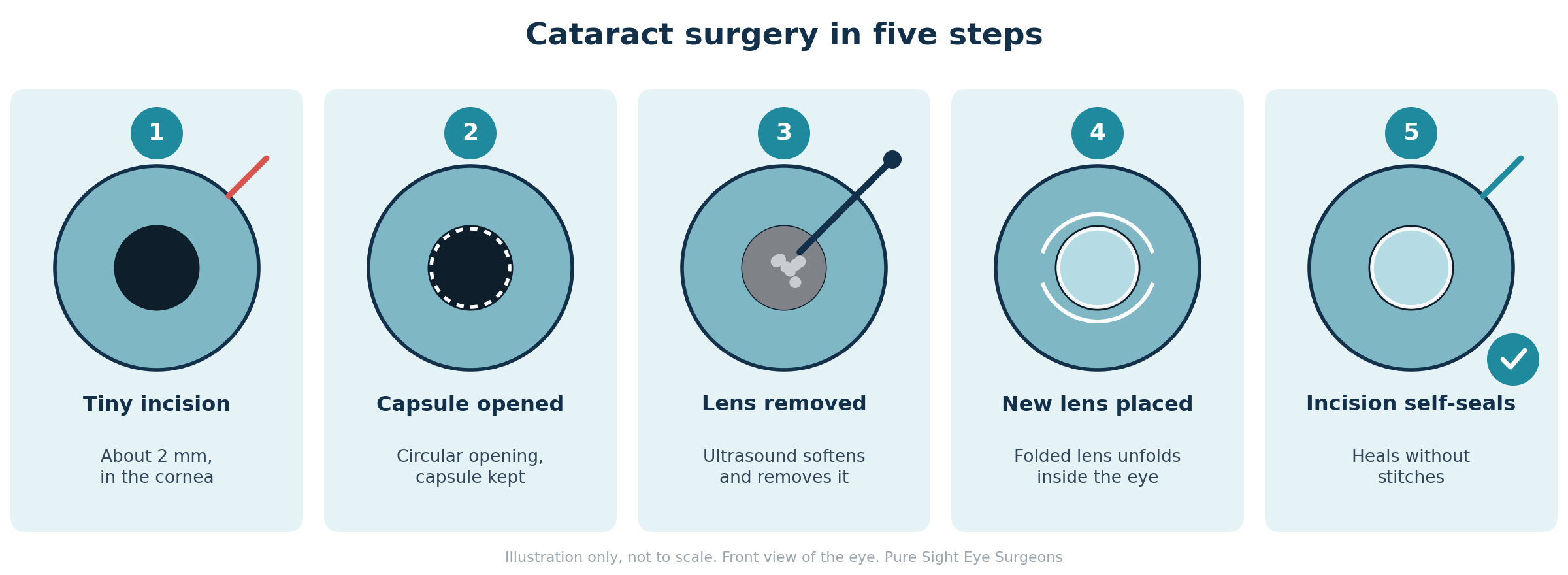
- A tiny incision is made. The surgeon makes a keyhole cut in the cornea, about 2 mm wide. That’s smaller than a grain of rice. Small incisions tend to seal well on their own, which is why stitches usually aren’t needed.
- The lens capsule is opened. Your natural lens sits inside a thin, clear bag called the capsule. The surgeon makes a neat, circular opening in the front of it. The bag itself stays in place, because it will hold your new lens.
- The cloudy lens is broken up and removed. A fine ultrasound probe softens the lens into tiny pieces. This step is called phacoemulsification. The pieces are gently drawn out through the same small incision.
- The new lens goes in. Your artificial lens, called an intraocular lens (IOL), is folded and slipped through the incision. Once inside the capsule, it unfolds into position. It’s permanent, and you won’t feel it.
- The incision seals itself. The cut is designed to close without stitches. The eye’s own pressure helps hold it shut while it heals.
- Final checks. Your surgeon checks the eye is stable, then a protective shield is placed over it. After that you move to the recovery area.
How long does cataract surgery take?
Cataract surgery usually takes about 10 to 20 minutes per eye. That’s the operating time only.
You’ll be at the day surgery for longer. Check-in, drops, preparation and a rest afterwards all add up. Plan for most of a morning or an afternoon, and don’t schedule anything important afterwards.
Surgery is usually done one eye at a time, a few weeks apart. This lets the first eye heal and gives your surgeon a chance to review your result before the second operation. In selected cases, both eyes can be done on the same day. That depends on your eye health, your general health and your lens plan. Most health funds don’t cover the second eye when both are done together, which can mean extra out-of-pocket costs. Our cataract surgery cost guide explains what to ask about.
What happens straight after surgery
You’ll rest in the recovery area for a short time. The team checks how you’re feeling and goes over your written instructions. These cover your eye drops and what to avoid. Keep the paperwork handy.
Your eye will have a shield on it. Someone needs to drive you home. You’ll usually come back for a check the next day.
Dr Chiu’s patients also get her mobile number. If something worries you in the first week, you can call. You don’t need to wait and wonder.
Every operation carries some risk, and cataract surgery is no exception. Your surgeon will go through the possible complications with you before you decide. Our week-by-week recovery guide covers what the following weeks look like.
When the approach is different
Everyone’s eyes are different, so not every cataract operation looks the same. Some situations call for extra planning:
- Very dense cataracts
- Previous laser or other eye surgery
- Astigmatism (an uneven curve in the front of the eye)
- Macular disease
- Diabetic eye disease
If any of these apply to you, your surgeon builds a plan around them at your assessment. That might affect the lens choice, the order of steps or how closely you’re monitored. Lens options are a big topic on their own. Our lens options guide is a good place to start.
Frequently asked questions
How long does cataract surgery take?
Cataract surgery usually takes about 10 to 20 minutes per eye. You’ll be at the day surgery for longer because of preparation and recovery. Surgery is normally done one eye at a time, a few weeks apart.
Are you awake during cataract surgery?
Yes, most people are awake. Your eye is numbed with anaesthetic drops, and sometimes a local anaesthetic injection, so you may feel pressure but not pain. You’ll see light and movement rather than the instruments.
Is cataract surgery painful?
Cataract surgery is not typically painful. The eye is numbed, so most patients feel only pressure or a mild sensation. Mild scratchiness afterwards is common. Contact the clinic if you have severe pain.
How do they keep your eye still during cataract surgery?
You lie comfortably flat, your eye is numbed and a small holder keeps your eyelids open so you can’t blink. You’re asked to look at the microscope light and stay still while your surgeon talks you through each stage.
Do I need someone to take me home after cataract surgery?
Yes, arrange for someone to take you home. Many patients can drive again within one to two days, once your vision has been checked at your post-operative review.
Can both eyes be done on the same day?
Sometimes. Same-day surgery is possible in selected cases, depending on your eye health, general health and lens plan. Most health funds don’t cover the second eye when both are done on the same day.
What lens is put in my eye?
A permanent artificial lens, called an intraocular lens (IOL), replaces your cloudy natural lens. Options include monofocal, toric, EDOF and multifocal lenses. Your surgeon recommends one after measuring your eye and discussing your lifestyle.
Why choose Pure Sight Eye Surgeons for cataract surgery in Sydney
Cataract surgery isn’t one-size-fits-all. At Pure Sight Eye Surgeons, your plan starts with a personalised vision assessment and a conversation about how you use your eyes day to day.
- Dr Alison Chiu, Specialist Eye Surgeon (FRANZCO, PhD, MBBS (Hons), BMedSc (Hons I), Grad Dip Refractive Surgery), has a special interest in cataract surgery, including refractive and complex cases. She tailors lens selection to each patient.
- Dr Adam Plant, Retinal and Cataract Surgeon (FRANZCO, PhD (Diabetic Retinopathy), BMed (Distinction)), treats retinal conditions and performs complex cataract surgery.
- Dr Joanne Teong, Ophthalmologist (FRANZCO, MBBS, BA/LLB), provides care in medical retina, glaucoma and cataract surgery.
You can see us at our consulting rooms:
- Paddington: 25 Norfolk Street, Paddington NSW 2021
- Richmond: 135 Windsor Street, Richmond NSW 2753
Surgery takes place at Sydney Surgical Centre (Randwick) and Somerset Day Surgery (Kingswood). To talk it through, call (02) 9098 1180 or book a personalised vision assessment. You can also read more on our cataract surgery page.
This article is general information only and isn’t a substitute for a consultation. All surgery carries risk. Ask a suitably qualified practitioner whether it’s right for you.
Further reading
- Cataract surgery
- Premium intraocular lenses
- Cataract surgery recovery: week by week
- Cataract surgery cost in Sydney
Medical references
- Healthdirect Australia. Cataract surgery
- Healthdirect Australia. Local anaesthetic
- Healthy WA, Government of Western Australia. Cataract surgery (phacoemulsification and intraocular lens)
- Cleveland Clinic. Cataract surgery